


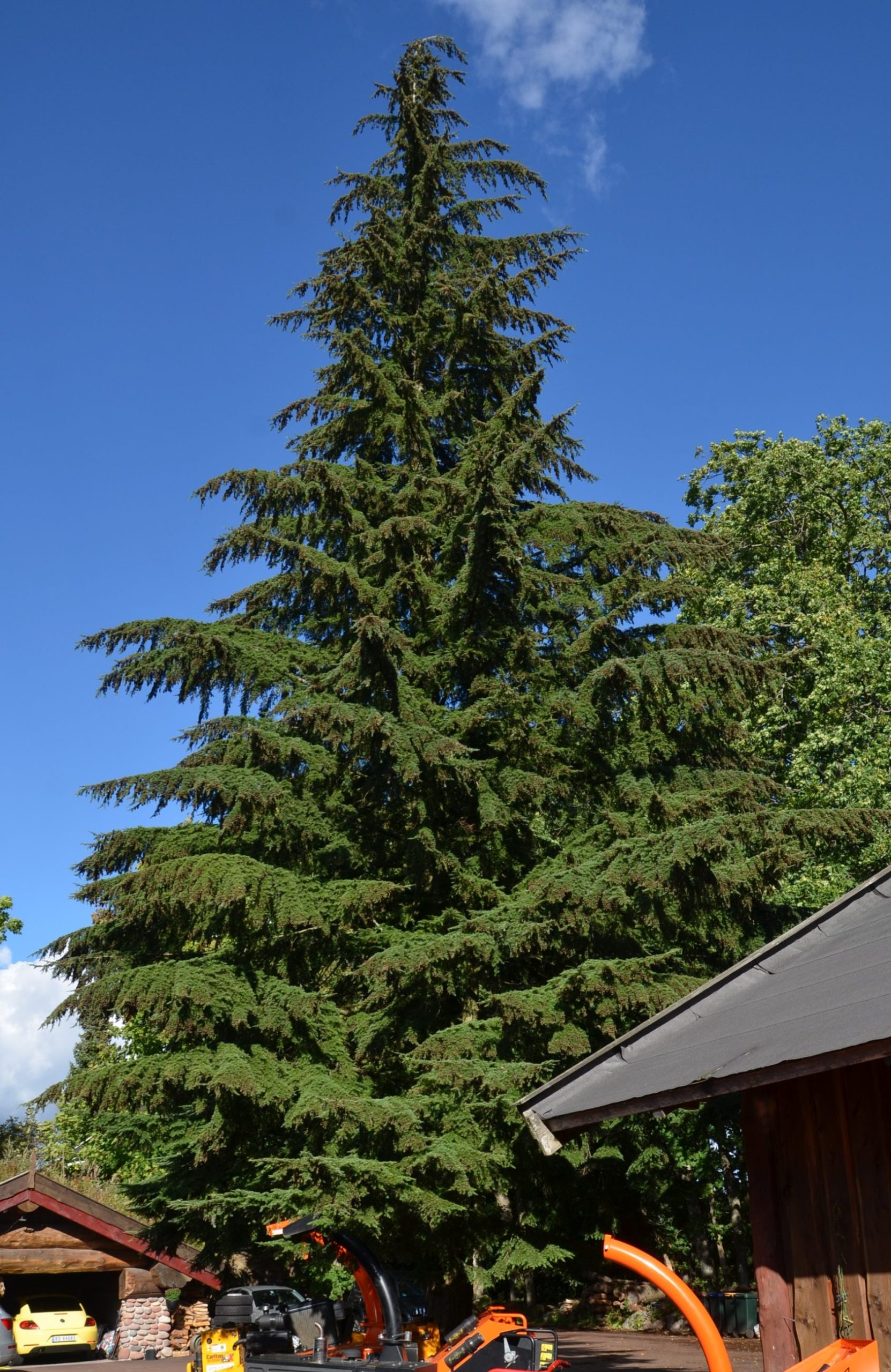
The East American species of hemlock is an important forest tree in its native countries of the USA and Canada. In this country, we are more interested in cultivars with compact growth. These become densely grown, multi-stemmed trees or compact shrubs with a seedling form.
Text and photo: Ole Billing Hansen
Tsúga canadénsis (L.) Carrière is found growing wild in the eastern parts of North America from Alabama to Nova Scotia, where the trees can grow up to 40 meters tall, but usually 25-30 meters. In free-standing trees, the crown is broadly cone-shaped, and the trees are usually single-stemmed with a trunk that can have a transverse dimension of up to 1.5 metres. The top shot is usually short and overhanging.
The trunk bark is cracked, deeply furrowed and dark reddish brown. The side branches are horizontal with an overhanging tip. The winter buds are 1-2 mm long, pointed and without resin. The twig is thin, light grey-brown and hairy. The needles sit in a screw position, but apparently out to two sides from the twig. Each pin blade has a short shaft. The needles are 6-20 mm long and taper evenly towards the tip, which is somewhat rounded. The leaf margin is finely toothed. The upper side is dull green with fine furrows, while the grey-white slit-opening bands on the underside are clearly separated by a green central rib. The needles usually stay on the twig for three years before falling off.
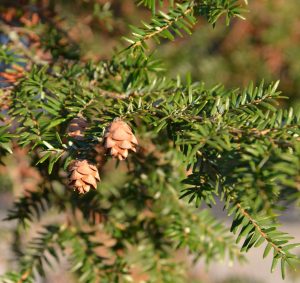
Both male and female inflorescences are formed on last year’s shoots. The male inflorescences are 3-6 mm long, lateral, round to cylindrical and have a short stalk. They are often blue-purple before flowering. The cones are terminal, first erect, but soon drooping. They are 12-24 mm long, oblong and often have a short shaft. The cone scales are thin, and the short covering scales are not visible on the outside of the cone. The tip of the cone shells is usually slightly bent back in mature cones. The cones mature in five to eight months and fall off in their second year. The seeds are 3 mm long and light brown.
Canada hemlock has a graceful growth and often light green bare color. They give a completely different impression to the often dark spruce and yew species. The name hemlokk was given by settlers in North America. They found that the resin from the tree could be poisonous and therefore used the name «Pix Hemlock» after the poisonous umbel plant Coníum maculátum (poison biscuit, skarndyde), which was used in ancient Greece.
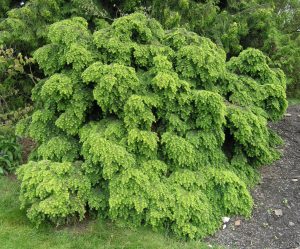
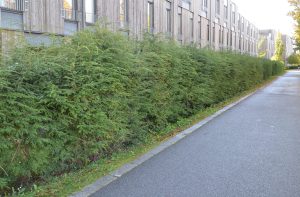
Canada hemlock was introduced to Europe by Peter Collinson in 1736. In the eastern United States and Canada, the species is an important timber tree. In this country, growth is more moderate, and the plants are often wide, multi-stemmed and rarely taller than 15 metres. Within the species there are a number of cultivars, especially those with compact growth, but hanging forms and name varieties with yellow or white mottled bars are also marketed. Late-growing cultivars may be suitable together with other evergreens or in the mountain garden. T. canadénsis ‘Pendula’ has often been planted in the past. This is almost a collective name for several different hanging forms. Plants with this cultivar name are usually no more than 2-3 meters high, but up to 6-7 meters wide. T. canadénsis ‘Jeddeloh’ lacks top-oriented shoots and becomes a dense, seed-shaped bush. In the USA and Canada, Canadian hemlock is widely used for clipped hedges. The species retains its needles even in very shady conditions.
Tsúga canadénsis is found growing wild in mountainous areas with high rainfall. When young, the plants form undergrowth in the forest. The species is adapted to a warmer and longer growing season than we have in Norway. Therefore, in some years we can see frost damage on last year’s poorly matured shoots, which can lead to multi-stemmed, bush-like plants. Drying winds in the spring when there is still deep soil in the soil can also cause scalding damage to the bar. Canada hemp generally does not thrive in wind and should be given a place to grow where the soil never dries out completely. The species likes nutrient-rich soil with medium to low pH and is winter hardy to zone 4-5. Canada hemlock is not susceptible to pests. The species is propagated by seed, while the cultivars are propagated by cuttings or by grafting.
The Hemlokk family includes nine or ten species of evergreen, sambo, cone-bearing trees. Today we find species in Asia and North America, but fossil finds show that the genus was represented in Europe before the last ice ages. Tsúga is the Japanese name for hemlock. Canada hem lids belong to the section Micropeúce , which have slit-opening bands only on the underside of the needles.